Lorenzo Magnino
I'm Lorenzo Magnino, a PhD Candidate at the University of Cambridge, supervised by Amanda Prorok.
My work now explores the intersection of Multi-Agent Robotics and Collective Intelligence. During my time at NYUShanghai I worked on Mean Field Games and Reinforcement Learning supervised by Mathieu Lauriere. I also interned at InstaDeep, working on GNNs for Multi-Agent Reinforcement Learning.
I love science, building things, playing music, and sports.
Research direction: Enabling physical agents to safely and continuously adapt to new situations in the world.
Feel free to write me on LinkedIn or connect directly by email.

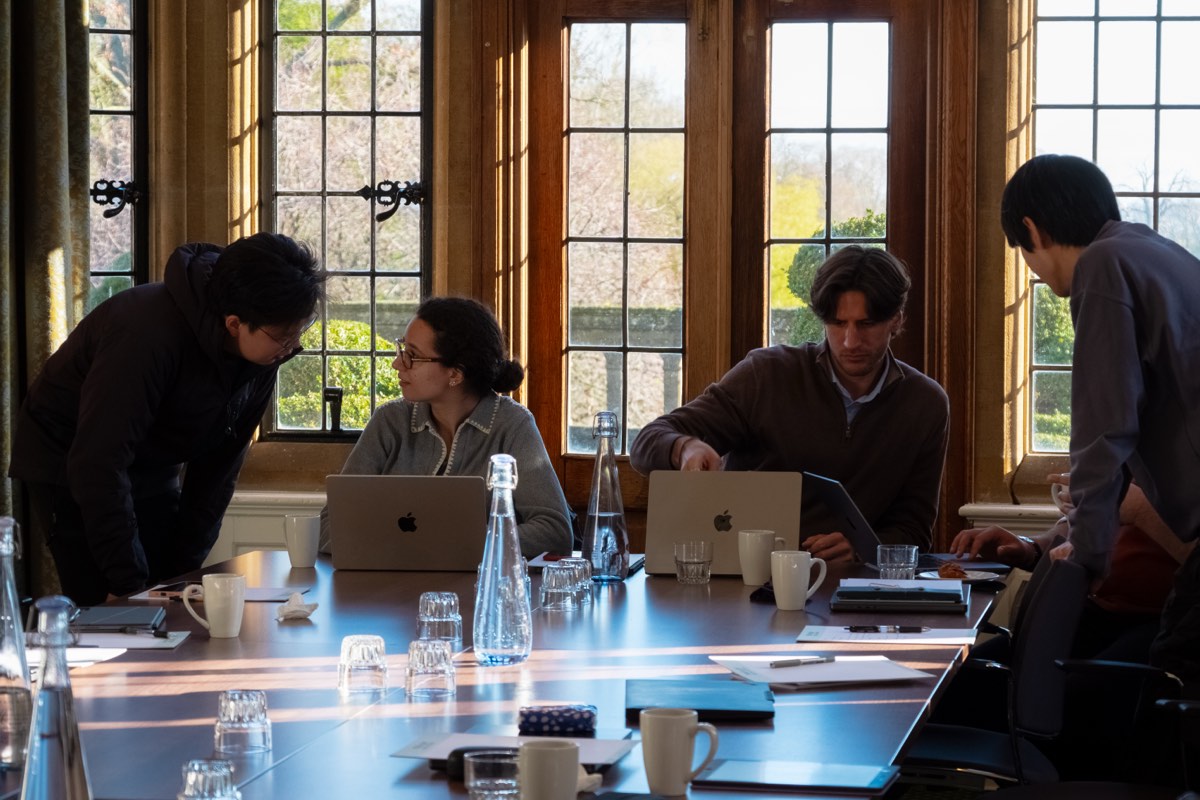
Snapshots from recent Symposium on "Future of Intelligent Robotics" in Cambridge.
News
- Oct 2026: Officially started my PhD at the University of Cambridge in the Department of Computer Science and Technology
- Jan 2026: Starting as TA for Robot Mobile Systems, course taught by Amanda Prorok, Cambridge University
- Jan 2026: ProbAI Winter School. Diffusion Models and Optimal Transport
- Dec 2025: Poster presentation at NeurIPS 2025 in San Diego
- Nov 2025: Talk at Symposium "Future of Intelligent Robotics" in Cambridge
- Oct 2025: Starting as a Research Assistant at the University of Cambridge, ProrokLab
- Jul 2025: Poster presentation at ICML 2025 in Vancouver
- Mar 2025: Intern at InstaDeep (MARL and GNN for routing and scheduling in a real world challenge)
- Sep 2024: Continue as Research Assistant at NYU Shanghai w. Mathieu Lauriere
- Mar 2024: Head to NYU Shanghai as a visiting student
Collaborations: University of Cambridge, NYU, UCLA, Earth Science Projects, KTH Royal Institute of Technology, Georgia Institute of Technology, TU Berlin, George Mason University.
Featured Publications
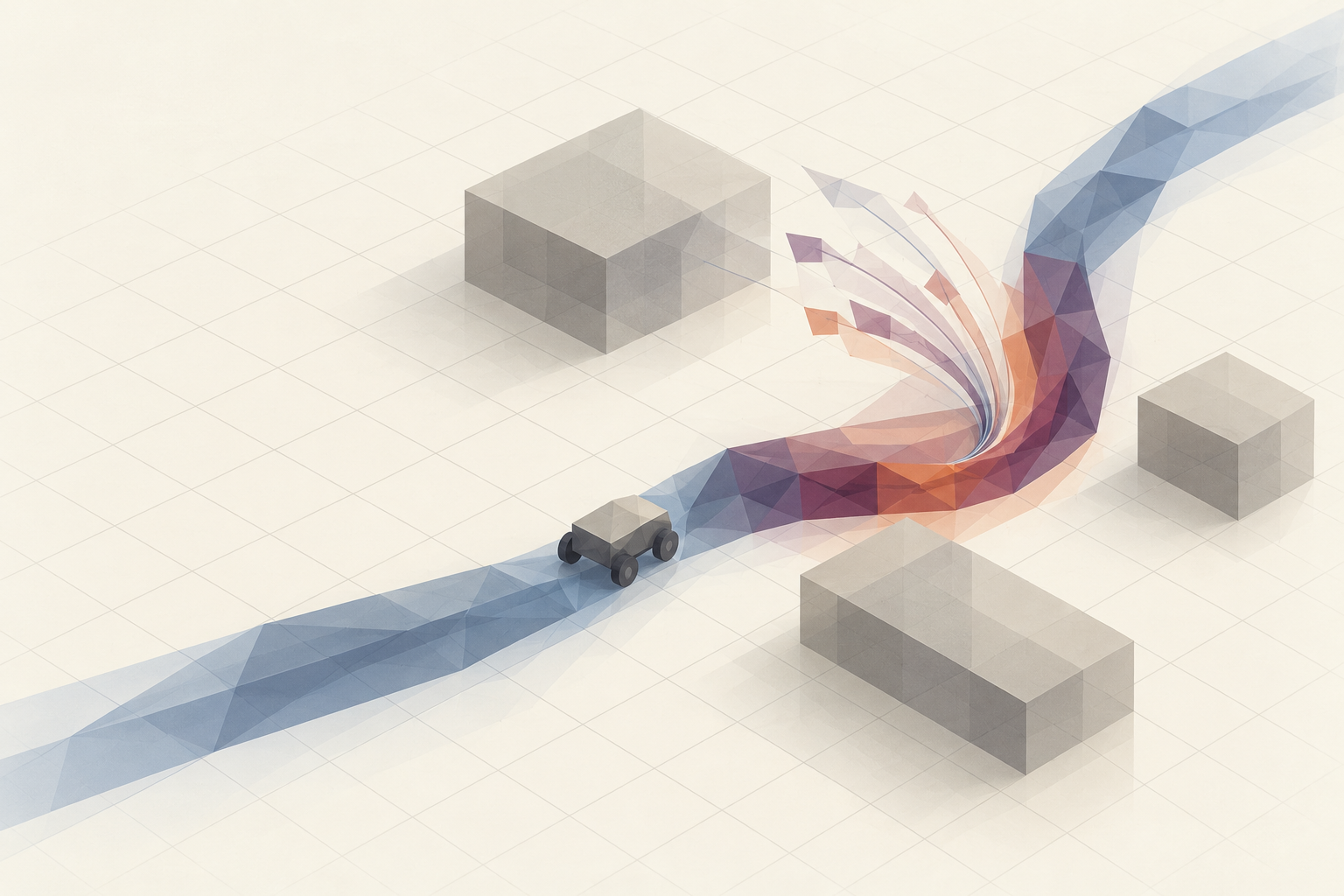
Learning Robot Metareasoning: Adaptive Computation Budgets for Real-Time Control
Lorenzo Magnino, Antonio Marino, Michael Amir, Daigo Shishika, Amanda Prorok
Preprint · 2026
Main Discovery
Robots can learn how long to plan before acting again. A state-dependent policy chooses both the action commitment and computation budget, balancing deeper planning with faster feedback as the task demands change.

GAMBIT: Learning to Plan Continuous Multi-Robot Trajectories
Rishabh Jain, Akmaral Moldagalieva, Lorenzo Magnino, Michael Amir, Keisuke Okumura, Ajay Shankar, Wolfgang Hönig, Amanda Prorok
Preprint · 2026
Main Discovery
Robots learn coordinated choices over motion primitives, including when to give way for the benefit of the team. Imitation learning followed by reinforcement learning produces scalable coordination, while backup trajectories safeguard collision-free execution.

Bench-MFG: A Benchmark Suite for Learning in Stationary Mean Field Games
Lorenzo Magnino, Jiacheng Shen, Matthieu Geist, Olivier Pietquin, Mathieu Laurière
NeurIPS 2026
Main Discovery
A shared benchmark makes learning algorithms for stationary mean field games easier to compare. Structured problem classes and randomly generated games reveal how methods behave across different forms of interaction, rather than on a few hand-picked examples.

Solving Continuous Mean Field Games: Deep Reinforcement Learning for Non-Stationary Dynamics
Lorenzo Magnino, Kai Shao, Zida Wu, Jiacheng Shen, Mathieu Laurière
NeurIPS 2025
Main Discovery
Combining fictitious play, deep reinforcement learning, and conditional normalizing flows makes it possible to learn equilibria in continuous mean field games while representing how the population distribution changes over time.
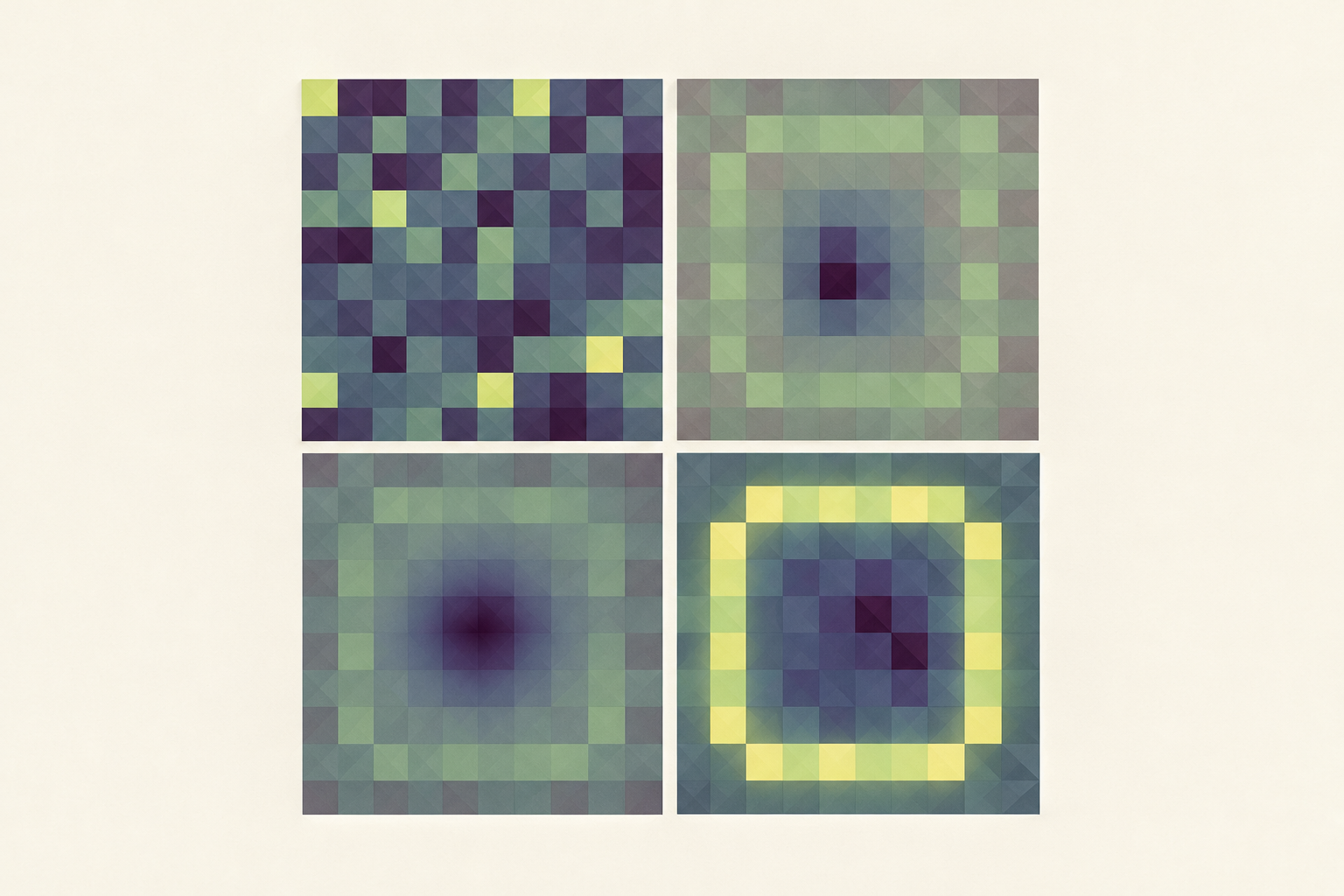
Learning to Stop: Deep Learning for Mean Field Optimal Stopping
Lorenzo Magnino, Yuchen Zhu, Mathieu Laurière
ICML 2025
Main Discovery
A large group of agents can learn when to stop by solving a mean-field approximation of their cooperative problem. A dynamic programming principle leads to two neural-network approaches that scale to high-dimensional settings.
Talks
- Prob_AI Winter School: Mathematical Foundations of Probabilistic AI Warwick University, Jan 2026
- NeurIPS 25: poster presentation San Diego, Dec 2025
- Cambridge CST Symposium: Foundation models in robotics Madingley Hall, Cambridge UK, Nov 2025
- Insta Deep AI week - Workshop: Graph Neural Network for Multi-Agent Routing Problem Berlin, Jul 2025
- ICML 25: poster presentation Vancouver, Jul 2025
- Seminar: “Latest advances in Dynamic Programming in Wasserstein spaces” with Professor M. Fischer Padova, Aug. 2023
-
Research internship with Professor M. Formentin Padova, Apr. 2022 – Jul 2022
High-dimensional Probability for Statistical Learning (using Dudley's inequality and covering numbers to derive an upper bound for the excess risk in machine learning theory)
Projects

RoboML Research Template
A lightweight, opinionated template for running machine learning and robotics research projects. It provides a standardized structure for experiments, data handling, logging, and evaluation, with ready-to-use configs and scripts for reproducible workflows.
ML/Robotics Community
★ Star and clone the repo!
...some interesing readings
- The Creative Act: A Way of being by Rick Rubin
- The art of doing Science and Engineering by R. Hamming
- What the Tortoise Said to Achilles by L. Carroll
- Why Greatness cannot be Planned by K. Stanley and J. Lehman